As many of you kick off 2026 planning (or find creative ways to avoid it), there’s one thread every marketing leader should weave through their plan: how you’ll lead your team’s development in AI. AI isn’t just another tool—it’s the #1 technology reshaping marketing jobs, workflows, and expectations. It deserves a thread in your plan.
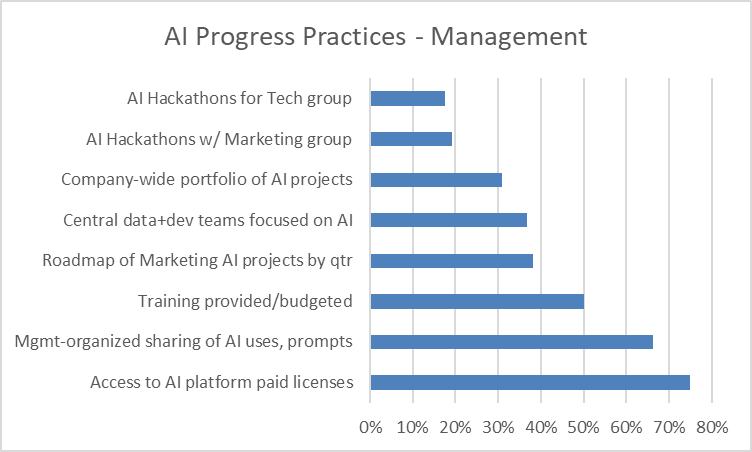
The AI Advantage Assessment data shows where marketing departments are progressing—and where leadership still needs to step up (click here for a graphic that summarizes the data used below)
Access is No Longer Optional
Marketing leadership moved fast here: 75% of organizations have already provided paid AI licenses to team members. That’s good news—but also a warning. If your department hasn’t budgeted for AI access, you risk looking behind the times. Future hires will expect this as standard, not special.
Leader takeaway: Make AI access part of your base operating budget, not an experiment.
Peer Learning Drives Real Adoption
65% of respondents said their leaders organized sharing sessions for AI use and prompts—a healthy start for building confidence and inspiration across the team.
But informal collaboration isn’t enough. Fewer than 20% of organizations have run cross-functional hackathons with IT—yet those collaborations are where process-level innovations happen (and where marketing departments can drive much greater business value).
Leader takeaway: Formalize peer-to-peer learning. Bring marketing and IT together at least once per quarter to co-develop AI use cases.
Centralized AI Project Strategy Is Still Missing
Only 30% of marketers are even aware of a company-wide AI project portfolio, and just 38% say their marketing team has an AI roadmap. That means most departments are still experimenting in silos—missing the compounding benefits of putting plans out for others to contribute, leaders to emerge and to get the benefit from coordinated investment.
Leader takeaway: Treat AI as a must-have capability, not a series of side projects. Assign ownership, publish a roadmap, and track progress like any other strategic initiative.
What This Means for You
Training and enablement are now table stakes. The leaders setting themselves apart are those who:
- Integrate AI conversations into team meetings and 1:1s,
- Sponsor cross-departmental projects (even the risky ones), and
- Communicate a clear departmental roadmap for AI progress.
In short: 2026 is the year AI leadership shifts from experimentation to management focus.Your challenge: Before finalizing your 2026 plan, ask yourself: Where in my organization is AI progress happening by luck—and where is it happening by design?
 AI Advantage Assessment
Leave a comment